
-
About
Marketing and ServiceBusiness consultation phone number:
-
Marketing and ServiceBusiness consultation phone number:
-
Application
Marketing and ServiceBusiness consultation phone number:
-
Technical support
Marketing and ServiceBusiness consultation phone number:
-
Marketing and ServiceBusiness consultation phone number:
Language

Common Technical Specifications for Industrial Cameras
Image field size
Closed-circuit surveillance cameras come with sensors of various sizes and specifications; the screen aspect ratio is typically 4:3 (horizontal width to vertical height). The size of the sensor affects the field of view—the same lens will yield a narrower field of view when used with a smaller sensor. The lens specifications, however, are independent of the field of view; all that matters is that the lens covers the entire sensor area—meaning that cameras of the same size or larger can use the same lenses. This also implies that a 1/3” camera can use any lens from 1/3” to 1”, for example, a 1/3” 12mm lens and a 2/3” 12mm lens will have the same field of view. The latter, though, will produce images with higher pixel density and better image quality, since it captures only the central portion of the lens’s field of view—a region that generally offers sharper images.
Focal length
Light rays coming from an object at infinity converge inside the lens onto a single point along the optical axis. The point on which the sensor of a CCTV camera focuses is called the focal point. In optical design, a lens has two principal points: a primary principal point and a secondary principal point. The distance between the secondary principal point and the focal point determines the lens’s focal length.
Field of view
The field-of-view angle refers to the angle formed by the lines connecting the lens to the edges of the image sensor. In theory, assuming the size of the camera’s imaging plane is not taken into account, a lens’s focal length is fixed, and so is its field-of-view angle. However, in practice, the field-of-view angle can also vary depending on changes in the size of the imaging plane. When the size of the imaging plane remains constant, if the focal length shortens, the field-of-view angle will correspondingly increase. The focal lengths listed in the catalog are nominal focal lengths; therefore, the field-of-view angles calculated using the formula are estimates.

Aperture
It is an index that measures the amount of light passing through a lens. The aperture value is represented by the F-number; the smaller the F-number, the greater the amount of light passing through, and the brighter the image formed by the lens. The F-number is inversely proportional to the lens aperture and directly proportional to the focal length.
The ratio formula is as follows:
F-number = f / D (f: focal length, D = lens aperture)
Automatic Aperture vs. Manual Aperture
Lenses are broadly categorized into three types: DC-driven aperture, video-driven aperture, and manual aperture. A DC-driven aperture is controlled by internal circuitry within the lens itself. A video-driven aperture incorporates an amplifier inside and is controlled by a video signal combined with DC power supplied by the camera. A manual aperture achieves aperture adjustments through a manually operated ring located on the exterior of the lens.
Depth of field
Depth of field refers to the range in front of and behind the focal point where sharp images can be formed after the camera lens has been focused. This distance—both in front of and behind the focal point—is known as the depth of field.
Aperture, lens, and the distance between the camera and the subject are important factors that influence depth of field.
1. The larger the aperture, the shallower the depth of field; the smaller the aperture, the greater the depth of field.
2. The longer the lens focal length, the shallower the depth of field; conversely, the shorter the focal length, the greater the depth of field.
3. The closer the subject is, the shallower the depth of field; the farther the subject is, the greater the depth of field.
4. The near depth of field is greater than the far depth of field.

Recent object distance
The recent object distance refers to the distance from the center point of the lens at the very front of the lens to the nearest object that can be imaged clearly.
CS and C interfaces
The back focal distance for CS-mount lenses is 12.5 mm, while the back focal distance for C-mount lenses is 17.5 mm. CS-mount lenses can only be used with CS-mount cameras. However, C-mount lenses, in addition to being compatible with C-mount cameras, can also be adapted for use with CS-mount cameras by adding a 5-mm C-to-CS adapter ring.
Back flange distance, back focal length, mechanical back focal length
The back focal distance refers to the distance from the lens mount to the camera sensor.
The back focal length refers to the distance from the center point of the lens’s last element to the camera sensor.
The mechanical back focal distance refers to the distance from the frontmost point of the lens mount to the camera sensor.

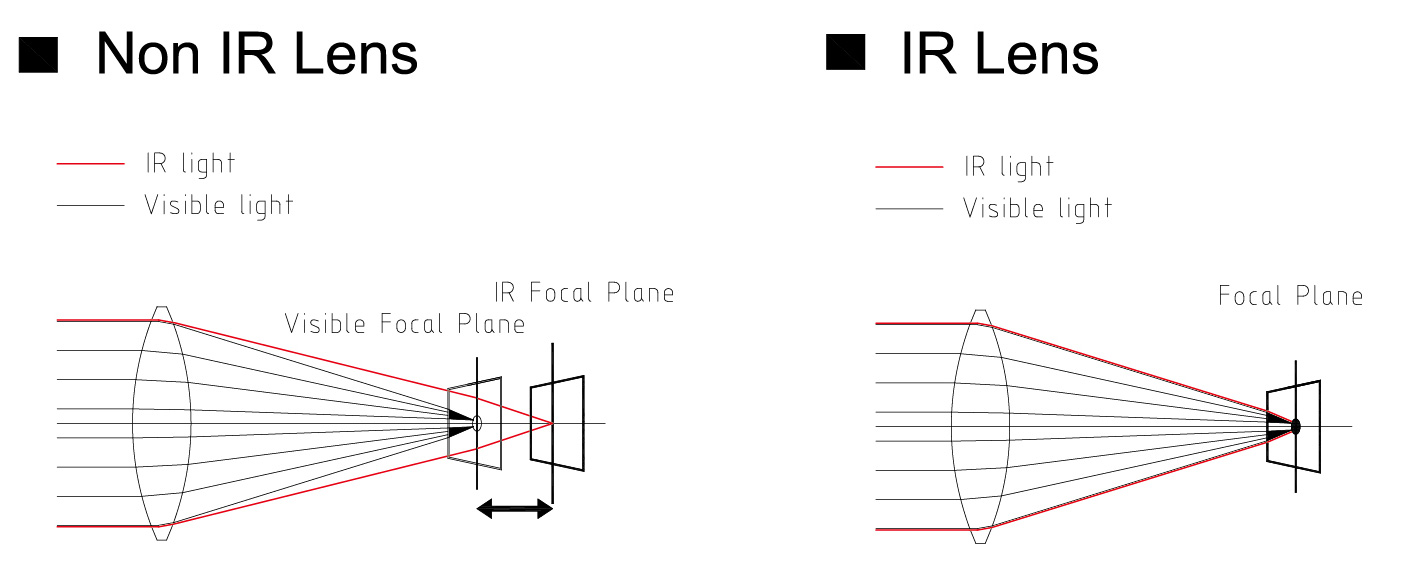
Comparison between non-IR lenses and IR lenses
Day-and-night cameras are typically used in near-infrared or infrared environments at night. If you pair a day-and-night camera with a lens that lacks IR correction capabilities, the camera will be unable to achieve sharp focus when used at night. EVETAR lenses employ glass elements combined with a specialized optical design and multi-layer coatings to minimize light refraction, enabling simultaneous focus in both day and night conditions. As a result, when the camera is used at night, there’s no need to refocus it again.
Megapixels
CCD and CMOS image sensors utilize pixels arranged in a two-dimensional grid. These pixels convert optical images into electronic signals. The number of pixels in an image typically determines its resolution—more pixels mean higher resolution. A “megapixel” refers to one million pixels. A megapixel camera is a camera that uses a megapixel sensor.
Previous page
Previous page
Champion Optics is a high-tech enterprise integrating the research and development of optical thin films, the development of new spectral instruments, and spectral image processing and application.
Language
Chinese
English
French
Russian
German
Quick Navigation
Follow us
Hotline:+86-431-86008533
Human Resources Consulting:+86-431-81785138
Email:lxq@championoptics.com
Email:
Address: No. 1759, Mingxi Road, Beihu Science and Technology Development Zone, Changchun City


Official website
Official WeChat