Champion Optics is a high-tech enterprise integrating the research and development of optical thin films, the development of new spectral instruments, and spectral image processing and application.
Thank you for your support of Champion Optics. If you have any after-sales questions, please feel free to contact us. You can also refer to the following FAQs to find solutions.
The term “linear” in a linear gradient filter refers to the fact that its spectral characteristics vary differently at different locations and change linearly with spatial position. Linear gradient filters offer advantages such as continuous wavelength variation, selectable channels, and stable performance. Thanks to processes like ion-assisted deposition or ion-beam sputtering, which involve depositing multilayer films of varying thickness onto the substrate surface to form wedge-shaped film layers, the filter’s spectral characteristics exhibit a linear variation.
Compared to traditional narrowband filters, linear gradient filters offer nearly continuous spectral channels; thus, using linear gradient filters for spectroscopy can achieve higher spectral resolution. Compared to spectroscopic imaging devices such as prisms and gratings, spectroscopic imaging systems based on linear gradient filters feature high integration, high stability, and high resolution. These systems boast a compact overall structure, small size, and light weight, while also exhibiting lower research and development and manufacturing costs, making them highly promising for practical applications. Linear gradient filters can also be used in areas such as portable spectrometers, secondary-order optical separation or cutoffs using gratings, and laser mirror design.
A linear-varying filter (LVF) is a novel spectroscopic component that has emerged following the development of prisms, gratings, and various recently introduced spectral-splitting elements. Compared with traditional spectroscopic components such as prisms and gratings, LVFs offer advantages including compact size, multiple transmission bands, and flexible tuning of band positions. Since LVFs can be combined with CCD/CMOS detector arrays to form detectors capable of spectral recognition, they greatly simplify spectroscopic systems and enhance instrument reliability, stability, and optical efficiency, thereby attracting increasing attention. Spectrometers featuring LVFs as their core spectroscopic element have been successfully applied in numerous fields, including aerospace, field exploration, atmospheric monitoring, food safety inspection, biofluid analysis, and multi-/hyperspectral imaging.
Application:
Spectral imaging technology
Compared to spectral imagers based on prisms and gratings, spectral imagers utilizing linear gradient filters boast advantages such as high integration, high stability, and high resolution. Their overall design is compact, with a small size and light weight, while also featuring lower research, development, and manufacturing costs, making them highly promising for practical applications.
Linear gradient filters can also be used in portable spectrometers, grating-based second-order light separation/cutoff, laser mirror designs, and other related fields.
Cut-off range: The cut-off range refers to the wavelength interval that represents the spectral region of energy attenuated by the filter. The degree of blocking is typically specified in terms of optical density.
Optical Density (OD): OD stands for optical density. When light passes through a sample, some of the light is absorbed. OD represents the measure of the energy blocked or rejected by the filter; it is a specialized term used in detection methods. The unit of measurement for OD is expressed as an OD value, calculated as follows: OD = lg(1/trans), where trans refers to the transmittance of the sample being measured. A high OD value indicates low transmittance, while a low OD value indicates high transmittance. An OD of 6.0 or greater is suitable for applications requiring extreme blocking, such as Raman spectroscopy or fluorescence microscopy. An OD between 3.0 and 4.0 is ideal for laser-based separation and purification, machine vision, and chemical detection, whereas an OD of 2.0 or less is optimal for color sorting and spectral order separation.
OD* indicates the cutoff; according to OD1 through OD6, the transmittance of the cutoff band ranges from 0.1 to 0.000001.
OD Number, Cut-off Wavelength Transmittance
OD1 = 0.1, which is 10%.
OD2 = 0.01, or 1%
OD3 = 0.001, which is 0.1%.
OD4 = 0.0001, which is 0.01%.
OD5 = 0.00001, which is 0.001%.
OD6 = 0.000001, which is 0.0001%.
Deadline number Deadline band
A 400~1100nm
B 300~1200nm
C 200~2000 nm
D 400~700nm
E 400~800nm
F 400~1000 nm
G 300~900nm
H 500~1000nm
I 800~1000nm
J 700~1200nm
K 200~1100nm
L 200~1200nm
M 200~1400nm
N 400~1200nm
O 200~1150nm
P 200~800nm
Q 350~700nm
U 200~700 nm
V 300~950nm
W 200~1000nm
X 200~750 nm
For example:
OD3-A: The transmittance of light waves within the wavelength range of 400–1100 nm is 0.001, excluding the spectral bands on either side of the central wavelength, each spanning half of the bandwidth.
OD3-B: The transmittance of light waves within the wavelength range of 300–1200 nm is 0.001, excluding the spectral bands on either side of the center wavelength, each spanning half of the bandwidth.
OD3-C: The transmittance of light waves within the wavelength range of 200–2000 nm is 0.001, excluding the spectral bands on either side of the central wavelength, each spanning half of the bandwidth.
OD3-D: The transmittance of light waves within the wavelength range of 400–700 nm is 0.001, excluding the band spanning half of the bandwidth on either side of the central wavelength.
OD3-K: The transmittance of light waves within the wavelength range of 200–1100 nm is 0.001, excluding the spectral bands on either side of the central wavelength, each spanning half of the bandwidth.
OD4-A: The transmittance of light waves within the wavelength range of 400–1100 nm is 0.0001, excluding the spectral bands on either side of the center wavelength, each spanning half of the bandwidth.
OD4-B: The transmittance within the wavelength range of 300–1200 nm is 0.0001, excluding the band spanning half of the bandwidth on either side of the central wavelength.
OD4-C: The transmittance within the wavelength range of 200–2000 nm is 0.0001, excluding the spectral bands on either side of the center wavelength, each spanning half of the bandwidth.
OD4-D: The transmittance of light waves within the wavelength range of 400–700 nm is 0.0001, excluding the band spanning half of the bandwidth on either side of the central wavelength.
OD4-K: The transmittance within the wavelength range of 200–1100 nm is 0.0001, excluding the spectral bands on either side of the center wavelength, each spanning half of the bandwidth.
The cutoff wavelength is a term used to denote the wavelength at which the transmittance through the filter increases to 50%. The cutoff wavelength is indicated by λcut-on in the figure below.
The cutoff wavelength is a term used to describe the wavelength at which the transmittance of a filter drops to 50%. The cutoff wavelength is denoted by λcut-off in the figure below.
Optical filters are optical devices used to select specific wavelength bands of radiation. They can selectively transmit a portion of the spectrum while blocking the transmission of the rest. Optical filters are commonly used in microscopes, spectroscopy, chemical analysis, and machine vision.
Transmittance (T): Suppose the initial light intensity is 100%. After passing through a filter, some light is lost. If the measured transmittance after filtering is only 80% of the initial value, then we say that the optical transmittance of this filter is only 80%.
Center Wavelength (CWL): The center wavelength used to define a bandpass filter is the midpoint of the spectral bandwidth over which the filter transmits. Specifically, it refers to the wavelength actually used in the filter’s practical application—for example, if the main peak of a light source is an 800 nm LED, then the required center wavelength would be 800 nm.
Full Width at Half Maximum (FWHM): The full name is “full width at half maxima,” often abbreviated as FWHM. It is used to characterize the bandwidth of the spectral range transmitted by a bandpass filter. Specifically, the upper and lower limits of this bandwidth are defined by the wavelengths at which the filter’s transmission reaches 50% of its maximum value. For example, if a filter has a maximum transmission of 90%, the wavelengths at which the filter’s transmission drops to 45% will define the upper and lower limits of the FWHM. An FWHM of 10 nm or less is considered narrowband and is commonly used in laser purification and chemical sensing applications. An FWHM between 25 and 50 nm is typically employed in machine vision applications; an FWHM exceeding 50 nm is regarded as broadband and is frequently used in fluorescence microscopy applications.
Fluorescence filters generally consist of a three-layer combination: an excitation filter, an emission filter, and a dichroic mirror.
Exciting Filter (Exciter Filter, Excitation Filter): In fluorescence microscopy, this filter allows only wavelengths that can excite fluorescence to pass through. Previously, short-wavelength-pass filters were used; nowadays, bandpass filters are predominantly employed. The filter housing is marked with an arrow indicating the recommended direction of light propagation.
Emitting Filter (Emission Filter, Barrier Filter, Emitter): This filter selects and transmits the fluorescence emitted by the sample while blocking other wavelengths of light. The emission wavelength is longer than the excitation wavelength (closer to the red end of the spectrum). Either a bandpass filter or a long-pass filter can be used as the emitting filter. The housing of the filter is marked with an arrow indicating the recommended direction of light propagation.
Dichroic Mirror (Dichroic Beamsplitter, Dichromatic Beamsplitter): Also known as a dichroic filter or color-splitting mirror. It is positioned at a 45° angle to the optical path of the microscope. This filter reflects one color of light (excitation light) and transmits another color of light (emission light). The reflectance of the excitation light exceeds 90%, and the transmittance of the emission light exceeds 90%. The portion of the spectrum that cannot pass through the filter is reflected rather than absorbed. Since the colors of the transmitted and reflected light are complementary to each other, this filter is also referred to as a dichroic filter.
Fluorescence filters, short for fluorescence imaging filters, are critical components used in biomedical and life science instruments. Their primary function is to separate and select the characteristic spectral bands of excitation light and emitted fluorescence in biomedical fluorescence detection and analysis systems. Typically, these filters are required to have an optical density (OD) cutoff depth of at least 5 (optical density, OD = -lgT). The core requirements for filters used in fluorescence detection systems include high cutoff steepness, high transmittance, high positioning accuracy, deep cutoff depth, and excellent environmental stability.
Closed-circuit surveillance cameras come with sensors of various sizes and specifications; the screen aspect ratio is typically 4:3 (horizontal width to vertical height). The size of the sensor affects the field of view—the same lens will yield a narrower field of view when used with a smaller sensor. The lens specifications, however, are independent of the field of view; all that matters is that the lens covers the entire sensor area—meaning that cameras of the same size or larger can use the same lenses. This also implies that a 1/3” camera can use any lens from 1/3” to 1”, for example, a 1/3” 12mm lens and a 2/3” 12mm lens will have the same field of view. The latter, though, will produce images with higher pixel density and better image quality, since it captures only the central portion of the lens’s field of view—a region that generally offers sharper images.
Focal length
Light rays coming from an object at infinity converge inside the lens onto a single point along the optical axis. The point on which the sensor of a CCTV camera focuses is called the focal point. In optical design, a lens has two principal points: a primary principal point and a secondary principal point. The distance between the secondary principal point and the focal point determines the lens’s focal length.
Field of view
The field-of-view angle refers to the angle formed by the lines connecting the lens to the edges of the image sensor. In theory, assuming the size of the camera’s imaging plane is not taken into account, a lens’s focal length is fixed, and so is its field-of-view angle. However, in practice, the field-of-view angle can also vary depending on changes in the size of the imaging plane. When the size of the imaging plane remains constant, if the focal length shortens, the field-of-view angle will correspondingly increase. The focal lengths listed in the catalog are nominal focal lengths; therefore, the field-of-view angles calculated using the formula are estimates.
Aperture
It is an index that measures the amount of light passing through a lens. The aperture value is represented by the F-number; the smaller the F-number, the greater the amount of light passing through, and the brighter the image formed by the lens. The F-number is inversely proportional to the lens aperture and directly proportional to the focal length.
The ratio formula is as follows:
F-number = f / D (f: focal length, D = lens aperture)
Automatic Aperture vs. Manual Aperture
Lenses are broadly categorized into three types: DC-driven aperture, video-driven aperture, and manual aperture. A DC-driven aperture is controlled by internal circuitry within the lens itself. A video-driven aperture incorporates an amplifier inside and is controlled by a video signal combined with DC power supplied by the camera. A manual aperture achieves aperture adjustments through a manually operated ring located on the exterior of the lens.
Depth of field
Depth of field refers to the range in front of and behind the focal point where sharp images can be formed after the camera lens has been focused. This distance—both in front of and behind the focal point—is known as the depth of field.
Aperture, lens, and the distance between the camera and the subject are important factors that influence depth of field.
1. The larger the aperture, the shallower the depth of field; the smaller the aperture, the greater the depth of field.
2. The longer the lens focal length, the shallower the depth of field; conversely, the shorter the focal length, the greater the depth of field.
3. The closer the subject is, the shallower the depth of field; the farther the subject is, the greater the depth of field.
4. The near depth of field is greater than the far depth of field.
Recent object distance
The recent object distance refers to the distance from the center point of the lens at the very front of the lens to the nearest object that can be imaged clearly.
CS and C interfaces
The back focal distance for CS-mount lenses is 12.5 mm, while the back focal distance for C-mount lenses is 17.5 mm. CS-mount lenses can only be used with CS-mount cameras. However, C-mount lenses, in addition to being compatible with C-mount cameras, can also be adapted for use with CS-mount cameras by adding a 5-mm C-to-CS adapter ring.
Back flange distance, back focal length, mechanical back focal length
The back focal distance refers to the distance from the lens mount to the camera sensor.
The back focal length refers to the distance from the center point of the lens’s last element to the camera sensor.
The mechanical back focal distance refers to the distance from the frontmost point of the lens mount to the camera sensor.
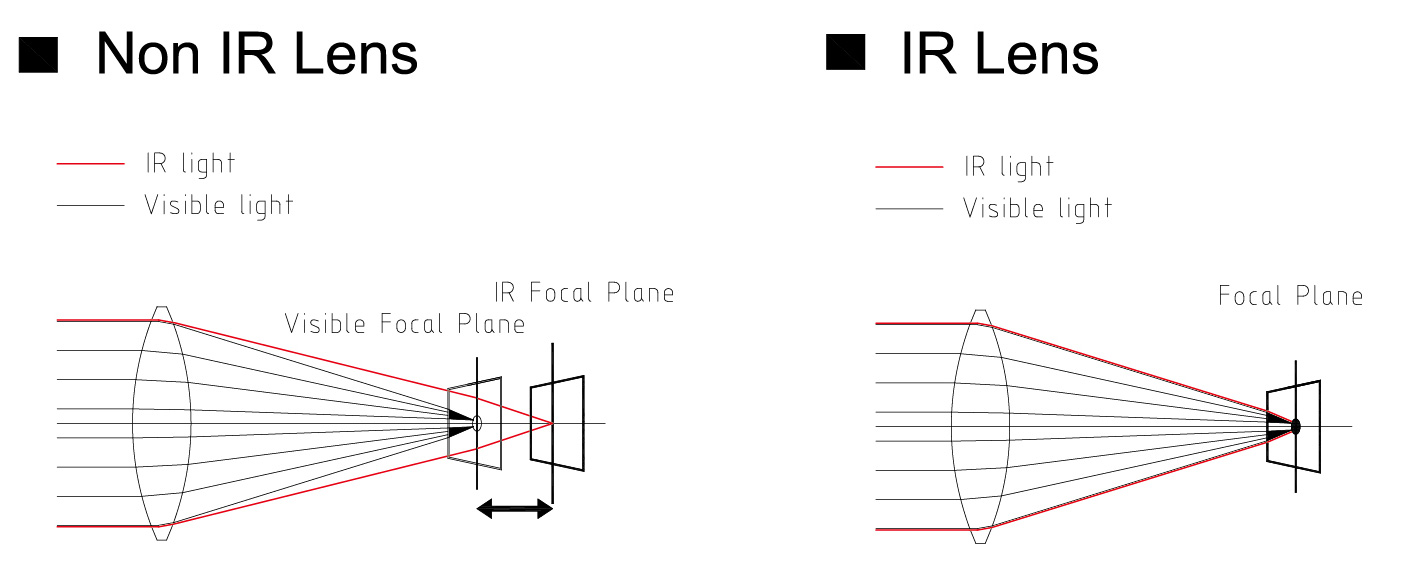
Comparison between non-IR lenses and IR lenses
Day-and-night cameras are typically used in near-infrared or infrared environments at night. If you pair a day-and-night camera with a lens that lacks IR correction capabilities, the camera will be unable to achieve sharp focus when used at night. EVETAR lenses employ glass elements combined with a specialized optical design and multi-layer coatings to minimize light refraction, enabling simultaneous focus in both day and night conditions. As a result, when the camera is used at night, there’s no need to refocus it again.
Megapixels
CCD and CMOS image sensors utilize pixels arranged in a two-dimensional grid. These pixels convert optical images into electronic signals. The number of pixels in an image typically determines its resolution—more pixels mean higher resolution. A “megapixel” refers to one million pixels. A megapixel camera is a camera that uses a megapixel sensor.
Filtering is an essential step in optical processes such as imaging and recognition, for example:
1. Infrared-cut filter: An optical filter that allows visible light to pass through while blocking or reflecting infrared light. This product is used in imaging cameras for applications including mobile phones, cameras, automotive systems, PCs, tablets, and security surveillance systems.
2. Low-pass filter: Removes moiré patterns and chromatic aberration corrections caused by high-frequency light waves. The product is used in digital cameras, video cameras, and surveillance monitors.
3. Under-display fingerprint filter: Allows green light to pass through while blocking all other wavelengths.
4. Narrowband Filter: A narrowband optical coating is deposited onto a substrate such as glass, enabling high transmission of light within a specific wavelength band while providing deep cutoff for other wavelengths. The filter also ensures minimal spectral shift even under large-angle incidence. This product is used in distance sensors and in the transmit and receive modules of 3D cameras.
In recent years, with the advancement of technologies such as multi-camera systems in mobile phones, periscope telephoto lenses, front-facing 3D structured light, rear-mounted Time-of-Flight (TOF) sensors, under-display fingerprint recognition, and glass back panels, the application of our company’s products in mobile phones has been steadily increasing, leading to a continuous rise in the value per device.
Multi-camera: Driving the Continued Growth of Infrared-Cut Filters
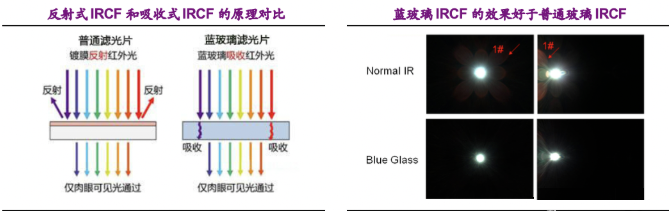
An infrared-cut filter is an optical filter that allows visible light to pass through while blocking infrared light. When light enters a lens and undergoes refraction, visible light and infrared light will be focused onto different image planes: visible light produces a color image, whereas infrared light produces a black-and-white image. Once the image formed by visible light has been properly adjusted, the infrared light will form a virtual image on the same image plane, thereby affecting the color and quality of the overall image.
Infrared-cut filters can be further subdivided into two types: reflective filters and absorptive filters. The most critical process in filter manufacturing is coating, which must ensure uniformity and consistency of the coating layer. Coating methods can be broadly categorized into vacuum coating and chemical coating. After coating, these filters can generally block light with wavelengths above 650 nm, thereby meeting basic application requirements.
The IRCF made by coating a blue glass substrate filters infrared light through absorption, effectively blocking wavelengths above 630 nm. In contrast, the IRCF made by coating a conventional glass substrate filters infrared light via reflection; however, the reflected light can easily cause interference and thus delivers a less effective performance compared to the blue-glass-based IRCF.
An important component of 3D cameras—narrowband filters
A narrowband filter is an optical component that allows only light of a specific wavelength to pass through while blocking all other wavelengths. In 3D sensing applications, the transmitting end emits infrared light at a wavelength of 940 nm, and the receiving end needs to filter out all other wavelengths and accept only the 940-nm infrared light; hence, a narrowband filter is required. The transmission band of a narrowband filter is relatively narrow, typically requiring a bandwidth of no more than 5% of the central wavelength.
The thin film of a narrowband filter typically consists of two types of layers—low-refractive-index and high-refractive-index materials—stacked together to form dozens of layers. Any drift in the parameters of individual thin-film layers can affect the overall performance. Moreover, the transmittance of a narrowband filter is highly sensitive to losses in the thin films; thus, it is extremely challenging to fabricate filters with both very high peak transmittance and a narrow full-width at half-maximum (FWHM). There are many different methods for fabricating thin films, including chemical vapor deposition, thermal oxidation, anodization, sol-gel processing, atomic layer deposition (ALD), atomic layer epitaxy (ALE), and magnetron sputtering. The performance of thin films prepared by these various methods can differ significantly.
Under-display fingerprint: Under-display fingerprint technology is rapidly gaining traction, driving increased demand for optical filters.
As the penetration rate of under-display fingerprint recognition solutions continues to rise, demand for optical filters is further increasing.
Fluorescence, a Chinese term also written as “yingguang,” refers to a cold luminescent phenomenon in which a substance emits light upon being excited by incident light of a certain wavelength—typically ultraviolet or X-ray. When a substance at room temperature absorbs energy from such incident light, it enters an excited state and then immediately de-excites, emitting light at a longer wavelength than that of the incident light (usually within the visible spectrum). For many fluorescent substances, the emission ceases immediately once the incident light is removed. The emitted light with these characteristics is called fluorescence. Additionally, some substances continue to emit light for a relatively long time even after the incident light has been turned off; this phenomenon is known as phosphorescence. In everyday life, people often broadly refer to any faint glow as fluorescence without carefully examining or distinguishing the underlying mechanisms responsible for the luminescence. It also refers to cool light with a low temperature (not color temperature).
The principle behind fluorescence
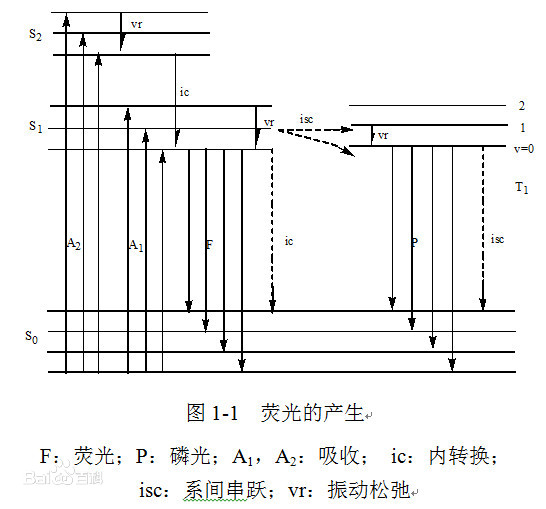
When light shines on certain atoms, the energy of the light causes some electrons surrounding the atomic nucleus to jump from their original orbits to higher-energy orbits—transitioning from the ground state to the first excited singlet state or the second excited singlet state, and so forth. Since the first excited singlet state or the second excited singlet state are unstable, they eventually return to the ground state. As the electrons fall back from the first excited singlet state to the ground state, the excess energy is released in the form of light, thus producing fluorescence.
Fluorescence is the emission of light by a substance after it has absorbed light or other electromagnetic radiation. In most cases, the emitted light has a longer wavelength and lower energy than the absorbed light. However, when the absorption intensity is sufficiently high, two-photon absorption may occur, leading to emitted radiation with a shorter wavelength than the absorbed light. When the wavelength of the emitted radiation matches that of the absorbed light, this phenomenon is known as resonant fluorescence. A common example is the absorption of ultraviolet light by a substance, which then emits visible-light fluorescence. The fluorescent lamps we use in everyday life operate on this principle: the phosphor coating inside the lamp tube absorbs the ultraviolet light emitted by the mercury vapor within the tube and subsequently re-emits visible light, making it visible to the human eye.
Fluorescence parameters
(1) Excitation Spectrum: The relationship between the intensity or luminescence efficiency of a specific emission line or band of a luminescent material and the wavelength of the excitation light under illumination by light of different wavelengths.
(2) Emission Spectrum: The variation in the intensity of luminescence at different wavelengths when a luminescent material is excited by a specific excitation light.
(3) Fluorescence Intensity: The fluorescence intensity is related to factors such as the fluorescence quantum yield, extinction coefficient, and concentration of the substance.
(4) Fluorescence quantum yield Q: The quantum yield represents a substance's ability to convert absorbed light energy into fluorescence; it is the ratio of the number of photons emitted by a fluorescent substance to the number of photons absorbed.
(5) Stokes shift: The Stokes shift is the difference between the wavelength of maximum fluorescence emission and the wavelength of maximum absorption.
(6) Fluorescence lifetime: When a beam of light excites a fluorescent substance, the molecules of the fluorescent material absorb energy and transition from the ground state to an excited state. They then emit fluorescence in the form of radiation as they return to the ground state. The fluorescence lifetime is defined as the time required for the fluorescence intensity of the molecules to decrease to 1/e of its maximum intensity at the moment when excitation ceases.
Cadmium selenide quantum dots emit fluorescence when exposed to ultraviolet light.
Applications of fluorescence
Lighting
Fluorescent lamp
A common fluorescent lamp is a prime example. The inside of the lamp tube is evacuated and then filled with a small amount of mercury. When an electric discharge occurs between the electrodes inside the tube, the mercury emits light in the ultraviolet spectrum. This ultraviolet light is invisible and harmful to human health. Therefore, the inner surface of the lamp tube is coated with a substance called phosphor (or fluorescent material), which absorbs the ultraviolet light and re-emits it as visible light.
Light-emitting diodes (LEDs) that can emit white light also operate on a similar principle. The light emitted by semiconductors is blue, and this blue light can excite phosphors—such as phosphorus—attached to the reflective electrode, causing them to emit orange fluorescence. When these two colors of light are mixed together, they approximate white light.
Highlighter
Highlighters contain fluorescent dyes that produce a fluorescent effect when exposed to ultraviolet light—such as sunlight, daylight lamps, or mercury lamps. Under UV illumination, these highlighters emit white light, giving the colors a striking, fluorescent appearance. The fluorescence of highlighters differs from that of watches or glow sticks: glow sticks rely on an internal radioactive reaction that generates radiation, which in turn excites the surrounding fluorescent powder to emit light. As a result, glow sticks can continue to glow even in the absence of any UV light at night. In contrast, highlighters only exhibit fluorescence when exposed to UV light. You can easily verify this by holding the highlighter’s mark close to a mosquito trap or a banknote detector—both of which emit UV light.
Biochemical and medical
Fluorescence has wide-ranging applications in the fields of biochemistry and medicine. By means of chemical reactions, fluorescent chemical groups can be attached to biomolecules, and then these biomolecules can be sensitively detected by observing the fluorescence emitted by the labeled groups.
DNA sequencing profile obtained using a fluorescently labeled chain-terminating agent.
The chain-termination method for automated DNA sequencing: In the original method, the primer ends of DNA had to be labeled with fluorescent dyes to enable precise identification of DNA bands on the sequencing gel. In the improved method, the four types of dideoxynucleotides (ddNTPs)—which serve as chain terminators—are each individually labeled with fluorescent dyes. After electrophoresis, DNA molecules of different lengths separate according to their sizes. Upon exposure to ultraviolet light, the four differently labeled dideoxynucleotides emit fluorescence at distinct wavelengths. By analyzing the fluorescence spectrum, the DNA sequence can be accurately determined. DNA detection: Ethidium bromide is a fluorescent dye that emits only very weak fluorescence when it freely changes its conformation in solution. However, once it intercalates between base pairs in the double helix of nucleic acids and binds to DNA molecules, it produces intense fluorescence. Therefore, ethidium bromide is commonly added during gel electrophoresis to stain DNA. DNA microarrays (biochips): Genomic probes must be labeled with fluorescent dyes, and the target sequences are ultimately identified by analyzing the resulting fluorescent signals. Immunofluorescence assay in immunology: Antibodies are labeled with fluorescent dyes, allowing researchers to determine the location and nature of antigens based on the distribution and morphology of the fluorescence. Flow cytometry (also known as fluorescence-activated cell sorting, FACS): Sample cells are labeled with fluorescent dyes, then excited by laser beams to produce specific fluorescence. The emitted fluorescence is detected by an optical system and transmitted to a computer for analysis, thereby revealing various characteristics of the cells. Fluorescence technology is also applied to detect and analyze the molecular structures of DNA and proteins, especially those of complex biological macromolecules. The jellyfish luminescent protein was first isolated from the marine organism Aequorea victoria. When coexisting with calcium ions, it emits green fluorescence. This property has been utilized to observe in real time the movement of calcium ions within cells. The discovery of the jellyfish luminescent protein spurred further research on marine jellyfish and led to the identification of Green Fluorescent Protein (GFP). The polypeptide chain of GFP contains a unique chromophore structure that allows it to emit stable green fluorescence upon exposure to ultraviolet light without requiring any additional cofactors or special treatments. As a result, GFP and related proteins have become essential tools in biochemical and cellular biology research. Fluorescence microscopy: Total internal reflection fluorescence microscopy—many biomolecules possess intrinsic fluorescence and can emit fluorescence without the need for additional chemical groups. Sometimes, this intrinsic fluorescence can change in response to environmental conditions, making it possible to use such fluorescence sensitivity to the environment to detect the distribution and properties of molecules. For example, bilirubin, when bound to a specific site on serum albumin, emits strong fluorescence. Similarly, when red blood cells lack iron or contain lead, they produce zinc protoporphyrin instead of normal heme (hemoglobin); zinc protoporphyrin exhibits intense fluorescence and can thus be used to help identify the underlying cause of certain diseases.
Gems, minerals
Gems, minerals, fibers, and other materials that can serve as forensic evidence may emit fluorescence of varying characteristics when exposed to ultraviolet or X-ray radiation.
Rubies, emeralds, and diamonds can emit red fluorescence under short-wavelength ultraviolet light. Emeralds, topaz (yellow jade), and pearls can also fluoresce under ultraviolet light. Additionally, diamonds can exhibit phosphorescence under X-rays.
Conceptual distinction
Luminescence induced by excitation from light (typically ultraviolet or X-rays) is called photoluminescence, which includes phenomena such as fluorescence and phosphorescence. Luminescence caused by chemical reactions is known as chemiluminescence; the fluorescent sticks used at concerts emit light through a chemical reaction triggered by the mixing of two liquid chemicals. Luminescence induced by cathode rays (a beam of high-energy electrons) is called cathodoluminescence—this is precisely how the fluorescent screen in a television’s cathode-ray tube emits light. The phenomenon of cold luminescence in living organisms is called bioluminescence; for example, the light emitted by fireflies is referred to as “yingguang.” In ancient Chinese, the character “ying” was used interchangeably with “ying,” and in some Chinese-speaking regions, the character “ying” is specifically associated with insects. In Taiwan, fluorescence is often referred to as “yingguang”; on the Chinese mainland, it is more commonly called “yingguang,” whereas “yingguang” typically refers specifically to the light emitted by fireflies.
Instrument
Fluorescence measurement absolutely requires an instrument. The instrument commonly used to detect the amount of fluorescence contained in a substance is called a fluorescence spectrophotometer.
The basic structure of a fluorescence analyzer includes: an excitation light source, an excitation monochromator, a sample chamber, an emission monochromator, and a detection system.
1. When handling optical lenses, always wear finger cots. If your hands come into contact with substances such as acids or salts that can easily corrode the glass surface, do not touch the optical lenses directly with your bare hands. This could leave marks on the lenses. If these marks are left unattended for an extended period, they may become permanent blemishes, adversely affecting the imaging quality of the optical components.
2. When handling optical lenses, handle them with care. Many optical lenses are made of glass and are prone to dents, chipped edges, and scratches.
3. When handling mobile optical lenses, always grip the edges of the lenses—never touch the optical surfaces directly. Even when wearing finger cots, avoid direct contact with the lens surfaces.
4. When not using optical lenses, place them on a soft surface. Do not place the lenses directly on glass, metal, desks, or dirty paper surfaces, as this can easily cause scratches on the lenses.
5. When there is dust on the lens surface, use a clean ear bulb to gently blow the dust off.
6. When the lens has smudges or sweat marks, gently wipe it with lens-cleaning paper or silk cloth dampened with alcohol or acetone.
7. When storing lenses, wrap them in clean capacitor paper or lens-cleaning wipes. Store them in an environment with a moderate temperature—around 23°C—and a humidity level below 40%. If possible, store them in a desiccant cabinet.
8. When storing lenses, do not stack optical lenses on top of each other; each lens must be placed separately without overlapping.
9. When the lenses get dirty, clean them immediately—but be careful not to scratch them, as dust can easily cause scratches on the lenses.
An enzyme-linked immunosorbent assay (ELISA) reader, also known as an ELISA detector, is a specialized instrument designed for use in enzyme-linked immunosorbent assays. In essence, it is a type of modified, specialized spectrophotometer or colorimeter. Its basic operating principle and main structural components are fundamentally the same as those of a conventional spectrophotometer. ELISA readers can be broadly categorized into two types: semi-automatic and fully automatic. However, their underlying working principles are essentially identical; at their core lies a colorimeter—a device that uses colorimetric analysis to determine the concentration of antigens or antibodies.
What is the enzyme-linked immunosorbent assay?
The enzyme-linked immunosorbent assay, often abbreviated as ELISA, is a type of labeling technique that has evolved from fluorescent antibody technology and isotopic immunoassay. It is a modern technique that is sensitive, specific, rapid, and capable of automation.
The basic principle of enzyme-linked immunosorbent assay (ELISA) is to conjugate an antigen or antibody with an enzyme using a coupling agent, thereby producing an enzyme-conjugated antigen or antibody. This enzyme-conjugated antigen or antibody can specifically react with the corresponding antigen or antibody immobilized on a solid-phase carrier or present in tissues, forming a stable immune complex that retains its biological activity. When a suitable substrate is added, the substrate is catalyzed by the enzyme, resulting in a characteristic color reaction. The intensity of the color is directly proportional to the concentration of the corresponding antigen or antibody.
Since this technology is based on the antigen-antibody reaction and the highly efficient catalytic action of enzymes, it boasts high sensitivity and specificity, making it a remarkably robust immunological assay technique.
The principle of an enzyme-linked immunosorbent assay (ELISA) reader.
An enzyme-linked immunosorbent assay (ELISA) reader is an instrument that operates on the principle of enzyme labeling. It is similar to a modified spectrophotometer or colorimeter, and its basic operating principle as well as its main structural components are essentially the same as those of a conventional spectrophotometer.
The light waves emitted by the light source are filtered through a filter or monochromator to become a beam of monochromatic light, which then enters the plastic micro孔 array containing the sample to be measured. Part of this monochromatic light is absorbed by the sample, while the remainder passes through the sample and strikes a photoelectric detector. The photoelectric detector converts these varying-intensity light signals from the sample into corresponding electrical signals. After undergoing signal processing—including pre-amplification, logarithmic amplification, and analog-to-digital conversion—the electrical signals are sent to a microprocessor for data processing and computation. Finally, the results are displayed on a monitor and printed out by a printer.
The microprocessor also controls the mechanical drive mechanism to move the microplate in the X and Y directions via control circuitry, thereby automating the sample-loading and detection process. In contrast, some other ELISA readers rely on manual movement of the microplate for detection, eliminating the need for mechanical drive mechanisms and control circuits in the X and Y directions. As a result, these instruments are more compact and have a simpler structure.
A microplate is a transparent plastic plate pre-coated and specifically designed to hold samples for analysis. The plate features multiple rows of uniformly sized, identical small wells, each containing a corresponding antigen or antibody. Each well on the microplate can accommodate a few tenths of a milliliter of solution. Common specifications include 40-well plates, 55-well plates, 96-well plates, and others. Different instruments are equipped with microplates of varying specifications, allowing for either single-well or row-by-row detection.
Enzyme readers measure the absorbance of the analyte at a specific wavelength. With the advancement of detection methods, single-unit desktop enzyme readers equipped with multiple detection modes are called multifunctional enzyme readers. These readers can detect absorbance (Abs), fluorescence intensity (FI), time-resolved fluorescence (TRF), fluorescence polarization (FP), and chemiluminescence (Lum).
From a principle standpoint, microplate readers can be categorized into grating-type microplate readers and filter-type microplate readers. Grating-type microplate readers can select any wavelength within the range of the light source’s spectrum, whereas filter-type microplate readers, depending on the selected filters, can only detect specific wavelengths.
Microplate Reader Structure
The monochromatic light used in enzyme readers can be obtained either through coherent filters or by means of a monochromator identical to that found in spectrophotometers. When using filters as filtering devices, just as in conventional colorimeters, the filters can be placed either in front of or behind the microplate; the effect is the same in either case. The light emitted by the source lamp passes through a condenser lens and an aperture, then reaches a mirror. After being reflected at a 90° angle by the mirror, the light travels vertically through the colorimetric solution and then passes through the filter before reaching the phototube.
Microplate readers can be categorized into two types: single-channel and multi-channel. Single-channel readers, in turn, come in two varieties: automatic and manual. Automatic models are equipped with mechanical drive mechanisms in the X and Y directions, enabling them to sequentially move the tiny wells of a microplate one by one beneath the light beam for testing. Manual models, on the other hand, rely on manual movement of the microplate to perform measurements.
Building upon the single-channel microplate reader, multi-channel microplate readers have been developed. These multi-channel readers are generally automated. They are equipped with multiple light beams and multiple photodetectors—for example, a 12-channel instrument features 12 light beams or 12 optical paths, 12 detectors, and 12 amplifiers. Under the mechanical drive in the X-direction, samples are scanned sequentially in rows of 12. Multi-channel microplate readers offer fast detection speeds, but their structure is more complex and they come at a higher price.
A fluorescence microscope is a type of optical microscope. When the specimen being observed is transparent or its internal structures cannot be clearly distinguished by color, a fluorescence microscope is an excellent choice, as it can overcome the limitations of ordinary microscopes in observing transparent materials. The principle behind a fluorescence microscope is to illuminate a specimen stained with a fluorescent dye using light of short wavelengths, which excites the dye molecules and causes them to emit long-wavelength fluorescence. This allows observers to examine the specimen's internal structure. In a fluorescence microscope, it is essential to select specific wavelengths of excitation light from the illumination source to generate fluorescence. Subsequently, the fluorescence must be separated from the mixed light consisting of both excitation and emitted fluorescence so that it can be observed clearly. Therefore, filter systems that selectively transmit specific wavelengths play an extremely important role in this process. Fluorescence microscopes are widely used in fields such as biology and medicine.
A fluorescence microscope consists of the following basic components:
a. Light source: Typically a xenon arc lamp or a mercury lamp, but high-power LEDs have also been used in recent years.
b. Filter (incident light): This filter reduces the wavelength of the incident light to leave only the wavelength needed to excite the sample; interestingly, it’s referred to as an excitation filter.
c. Two-way dichroic mirror or reflector: Reflects the excitation light onto the sample while simultaneously transmitting only the emission light originating from the sample to the detector (as shown in the figure below).
d. Emission filter: It allows only the emission wavelengths originating from the sample to pass through, while blocking all light that has passed through the excitation filter. As you might expect, it is referred to as an emission filter.
e. CCD Camera: If the emitted light cannot be detected, the camera is of no use at all. For fluorescence imaging, the detector is typically a CCD camera, which is usually connected to a computer screen and can display the image for you.
A dichroic beam splitter allows light with longer wavelengths to pass through the filter while reflecting light with shorter wavelengths.
Fluorescence Microscope Classification:
Fluorescence microscopes are generally divided into two types: transmitted-light and reflected-light.
a. Transmission Type: The excitation light originates from beneath the specimen, and the condenser is a dark-field condenser, which prevents the excitation light from entering the objective lens while allowing the fluorescence to pass into it. Under low magnification, the image appears bright; under high magnification, it becomes dark. This type of illumination is relatively difficult to adjust when using oil immersion or centering the microscope, especially in determining the appropriate illumination range at low magnifications. However, it can produce a very dark background for the specimen. The transmission-type illumination method is not suitable for specimens that are not transparent.
b. Epi-illumination: While transmitted-light microscopy has largely been phased out, most modern fluorescence microscopes now employ epi-illumination. In this configuration, the light source is positioned above the specimen, and a beam splitter is incorporated into the optical path, making it suitable for both transparent and opaque specimens. Since the objective lens functions as a condenser, this setup not only simplifies operation but also ensures uniform illumination across the entire field of view—from low to high magnification.